Work · Research note · September 2026
Are AI-exposed jobs losing young UK workers?
In 2025 a Stanford team found early-career workers in the most AI-exposed US jobs losing ground. I tested the same idea on UK data. The first chart said yes. The checks said not yet.
- Data
- ONS Annual Population Survey, 2020–2025
- Scores
- My UK exposure pipeline
- Methods
- Fixed panels, weighted regression, bootstrap
- Answer
- No robust evidence yet
The question
In 2025 Brynjolfsson, Chandar and Chen at Stanford reported that early-career workers in the most AI-exposed US occupations had started losing ground after late 2022, while older workers in the same jobs had not. They called them “canaries in the coal mine”.
Does the same pattern show up in the UK? The UK has no payroll data of the kind they used, but the ONS publishes employment by age and occupation from its Annual Population Survey.
First result
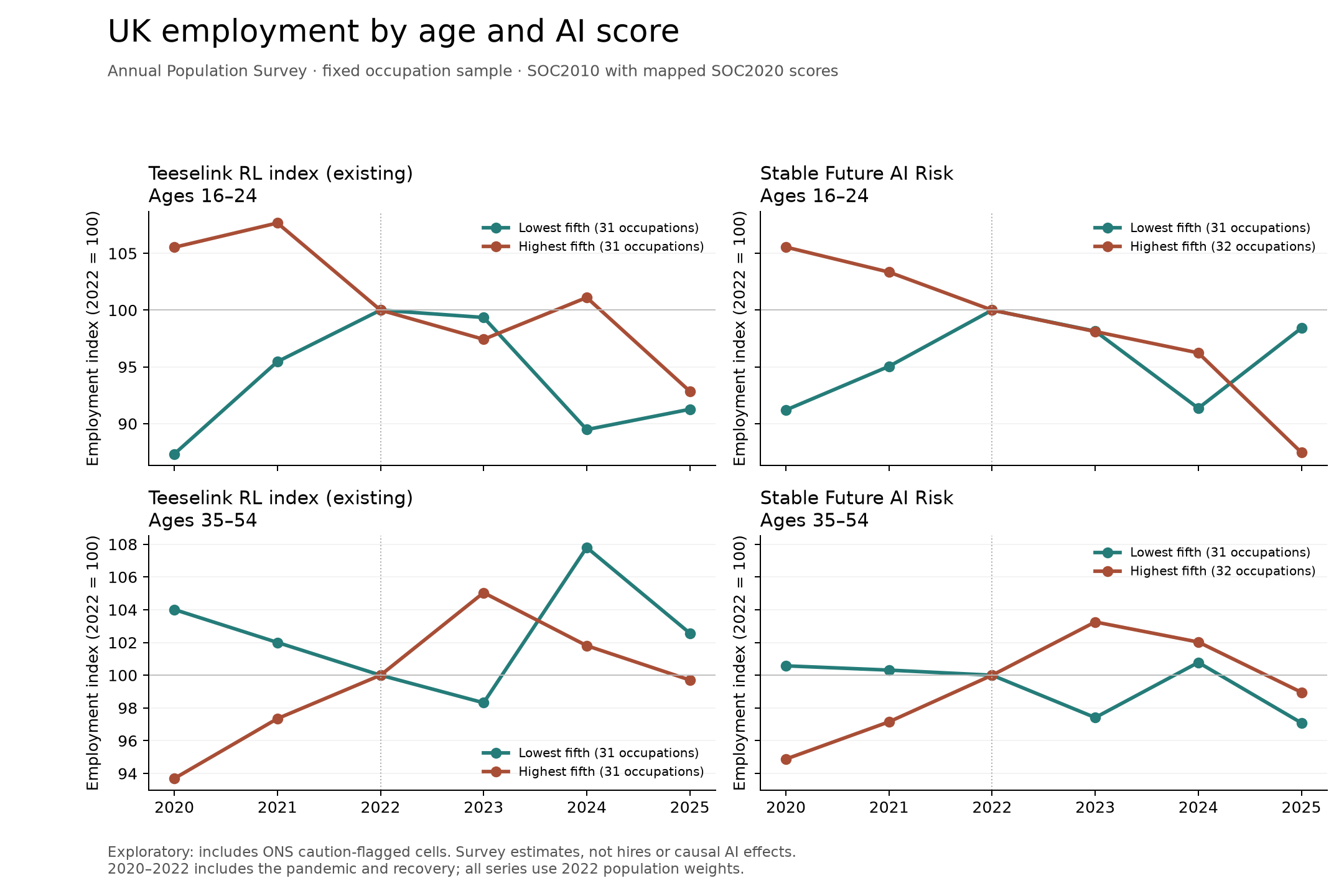
From 2022 to 2025, employment of 16 to 24-year-olds in the fifth of occupations with the highest AI risk score fell 12.5%. In the lowest fifth it fell 1.6%. For 35 to 54-year-olds the falls were 1.0% and 2.9%. That looks like the Stanford pattern.
The checks
It did not hold up.
- The exposure score alone gives no gap: young employment fell 7.1% in the highest fifth and 8.7% in the lowest.
- The high and low groups were already moving apart in 2020–2022, before ChatGPT. There is no clean break.
- Dropping every cell the ONS flags as unreliable leaves too few occupations to keep the pattern.
- A stronger ONS source (104 three-digit occupation groups, 2021–2025) gives a negative slope with a wide interval: −3.1 log points per 10 score points, 95% CI −7.9 to +1.8, p = 0.21.
What it means
UK survey data do not yet show a robust link between AI exposure and young workers’ employment. They cannot rule one out either: the samples are small, the age bands broad and the period short.
I wrote it up as “no clear evidence yet” rather than the headline the first chart offered. I bring the same habit to any AI project I scope: test the claim before building on it.